Why does hospital need a Non-Magnetic Medication Cart in the MRI Suite?
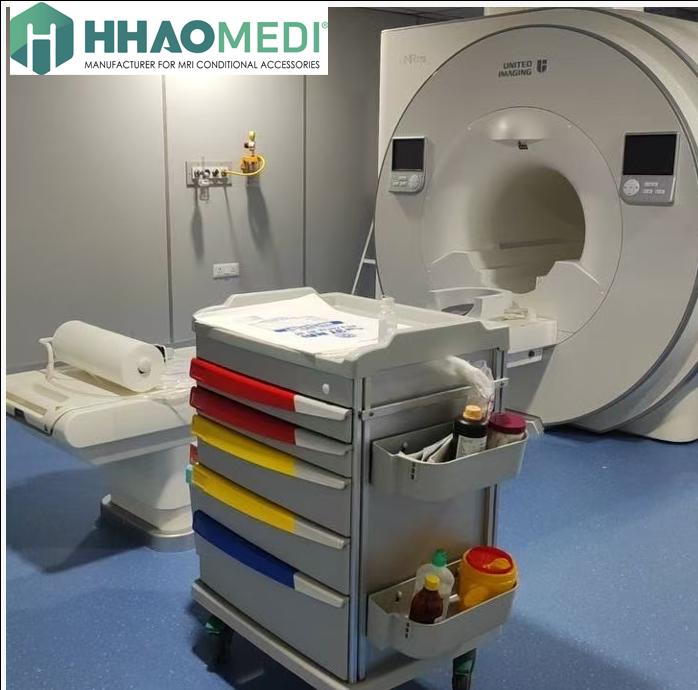
The Indispensable Role of a Non-Magnetic Medication Cart in the MRI Suite: Design, Integration, and Clinical Necessity
Magnetic Resonance Imaging (MRI) has revolutionized diagnostic medicine, offering unparalleled soft‑tissue contrast without ionizing radiation. However, the very strength of MRI—its ultra‑high‑field magnet (typically 1.5 to 3 Tesla, and higher in research settings)—introduces unique and potentially lethal hazards for any ferromagnetic object. In this environment, a conventional steel medication cart becomes a projectile, an image‑destroying artifact, and a fire hazard. Hence, the non‑magnetic (MR‑Conditional) medication cart is not a luxury but a fundamental safety requirement.
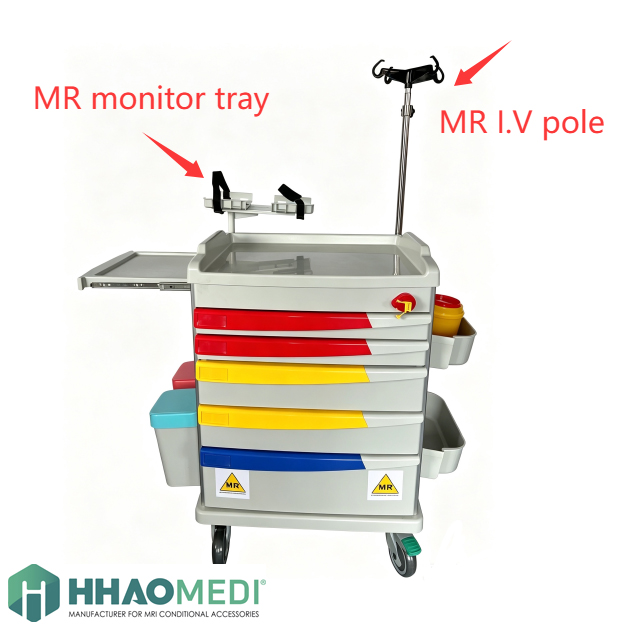
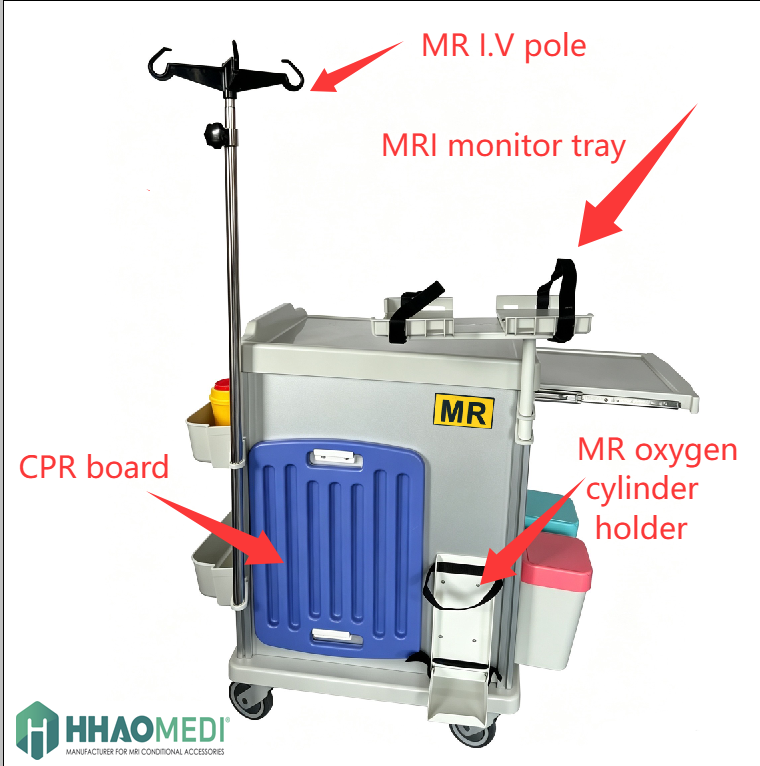
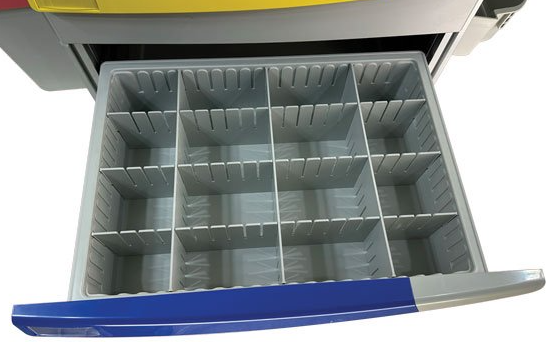
Yet, the need extends far beyond mere “non‑magnetic” construction. A truly functional MR‑compatible cart is a sophisticated mobile workstation, typically equipped with four casters, five to six lockable drawers with internal dividers for organized drug storage, and often additional life‑support accessories: a CPR board, a non‑magnetic oxygen cylinder holder, an IV pole, and a tray for a patient monitor or defibrillator. This article explains why such a cart must integrate all these features, and specifically, why a dedicated monitor/defibrillator tray—even though monitors usually have their own dedicated trolleys—is an essential component of the MR medication cart.
1. The Core Safety Challenge: Ferromagnetic Hazards
First and foremost, every component of the cart—from the casters to the smallest drawer latch—must be made of aluminium, high‑grade polymers, or other non‑ferromagnetic materials. This eliminates the “missile effect” (where the magnet pulls in steel objects at high speed), prevents radiofrequency‑induced heating, and avoids severe image artefacts that would render the scan useless. The cart is typically classified as “MR Conditional” under ASTM F2503, meaning it is safe only up to specified field strengths (e.g., ≤3 T).
But why the elaborate drawer system? The multiple drawers, each with adjustable dividers, allow for segregation of medications (e.g., emergency drugs, sedatives, contrast agents) and quick visual inventory. In a code situation, a nurse must locate atropine or epinephrine in seconds—organised drawers reduce cognitive load and save precious time.
2. The “Why” Behind Integrated Accessories: CPR Board, Oxygen Holder, IV Pole
When a patient experiences cardiac arrest or severe anaphylaxis during an MRI scan, the “golden minute” is critical. The MRI suite is often located away from the main emergency crash cart. A non‑magnetic medication cart that also carries a CPR board (a rigid plastic board placed under the patient to provide a firm surface for effective chest compressions), a non‑magnetic oxygen cylinder (aluminium alloy), and an IV pole transforms the cart into a mobile resuscitation station. These accessories ensure that oxygen, vascular access, and mechanical support are immediately available at the scanner bore, without needing to run out and retrieve them from separate locations.
3. The Monitor/Defibrillator Tray: Why Can’t We Just Use the Dedicated Monitor Trolley?
This is the most nuanced and frequently questioned point. Indeed, patient monitors and defibrillators typically come with their own dedicated, wheeled stands. So why must the MR medication cart also carry a tray for these devices?
The answer lies in three critical factors: spatial constraints, response time, and operational workflow.
-
Space is extremely tight in the MRI scan room. The bore of the magnet, the patient table, and the surrounding clearance area are minimal. Bringing an additional, separate trolley into the room not only clutters the narrow space but also obstructs the anaesthesiologist’s or radiologist’s access to the patient’s head and chest. During a resuscitation, every square centimetre matters—a second trolley can become a physical barrier that delays chest compressions or airway management.
-
Time is the essence in emergency. If the monitor is on its own trolley, that trolley must be fetched from a storage area (often outside the MRI suite’s Faraday cage). In a code, every second counts. By having the monitor tray already mounted on the medication cart, the entire set of rescue equipment—drugs, oxygen, IV, CPR board, and monitor—moves together as one unit, in a single trip. This eliminates the “two‑trip” delay and reduces the risk of forgetting any essential component.
-
Consistent readiness and standardisation. Hospital policy typically requires daily checking of emergency carts. When the monitor tray is fixed on the MR cart, it becomes part of the routine check‑list. Staff know exactly where the monitor is, and its battery is maintained as part of the cart’s inventory. In contrast, a separate monitor trolley may be borrowed for other procedures, leading to its absence when needed most. Integration ensures 100% availability of monitoring capabilities inside the MRI zone.
-
Avoiding cross‑contamination of MR safety status. A monitor that is MR‑Conditional may have its own dedicated non‑magnetic trolley, but that trolley might be inadvertently swapped with a standard steel trolley during cleaning or maintenance. By permanently fixing a compatible tray onto the MR‑specific cart, the hospital eliminates the risk of accidentally introducing a ferromagnetic stand into the scan room. This is a crucial risk‑management strategy.
4. Practical Benefits for the MRI Suite, Patients, and Hospital
For the MRI suite and staff:
-
Streamlined workflow: All necessary items (drugs, airway tools, circulatory support, monitoring) are in one place, reducing foot traffic and clutter.
-
Simplified training: Staff only need to familiarise themselves with one emergency cart, not multiple, for MRI‑specific emergencies.
-
Improved space utilisation: By merging functions, the suite remains uncluttered, allowing easier access to the patient table and the magnet.
For the patient:
-
Faster intervention: The immediate availability of monitoring and defibrillation within the scan room significantly improves survival outcomes in cardiac arrest.
-
Enhanced safety: The non‑magnetic construction eliminates any risk of burns or projectile injury during routine scans, even if the cart is accidentally left close to the magnet.
-
Continuity of care: The patient can be monitored and defibrillated without moving them out of the scanner, which is particularly beneficial for critically ill patients who cannot be easily transferred.
For the hospital administration and risk management:
-
Regulatory compliance: Meeting standards like those from The Joint Commission and local health authorities, which mandate that emergency equipment be immediately available in high‑risk areas.
-
Reduced liability: By proactively eliminating foreseeable hazards (missile effect, delayed resuscitation), the hospital reduces its exposure to malpractice claims.
-
Cost‑effectiveness: While the initial investment in an MR‑compatible cart is higher than a standard one, the avoidance of MRI downtime caused by “quenching” (a magnet quench from a ferromagnetic object) or costly image artefacts saves substantial operational costs. Moreover, integrating multiple functions into one cart reduces the total number of standalone trolleys needed, simplifying inventory management.
5. What Risks Are Avoided?
-
Projectile injuries – A steel oxygen cylinder or monitor stand can kill or maim.
-
Image artefacts – Even trace ferrous components on a separate trolley, if brought near the bore, can ruin a series of scans, requiring repeat examinations and delaying diagnosis.
-
Resuscitation delays – The most insidious risk is the time lost searching for or moving separate equipment. Integration directly addresses this.
-
Equipment damage – Non‑MR‑compatible devices can malfunction or be permanently damaged by the magnetic field, incurring costly repairs.
-
Human error – Standardising and fixing the location of all emergency gear minimises the chance of missing a critical item during an emergency.
Conclusion
The non‑magnetic medication cart with multiple drawers is not merely a passive storage unit; it is an active, life‑saving platform specifically engineered for the MRI environment. Its design—including the integrated tray for a monitor or defibrillator—addresses the unique spatial, temporal, and safety challenges of the MRI suite. While monitors do have their own separate trolleys in general wards, the MRI scan room demands a consolidated, one‑stop emergency response system that eliminates the delays, obstacles, and hazards associated with multiple independent devices.
Investing in a fully equipped MR‑Conditional cart demonstrates a hospital’s commitment to the highest standards of patient safety, staff protection, and clinical efficiency. In the high‑stakes setting of MRI, where seconds can make the difference between life and death, having everything—drugs, oxygen, CPR support, IV access, and monitoring—ready on a single, safe cart is not just convenient; it is ethically and clinically imperative.
 Sarah
Sarah Sarah
Sarah